

What businesses need to know
Britain’s electricity network is entering a major period of investment. Here’s what the £70 billion grid upgrade could mean for business energy costs.
Introduction
Britain’s electricity grid is undergoing its biggest transformation in decades, and somebody has to pay for it. With around £70 billion earmarked to modernise the transmission network, businesses will hear far more about grid upgrades, network charges and infrastructure costs over the next few years.
Those costs do not sit in the wholesale price that most procurement conversations focus on. They sit in the non-commodity section of the bill, which for many businesses now accounts for the majority of what they pay per unit. In this article, we explain where the money is going, why the upgrade cannot be avoided, and what businesses can do to keep control of their energy costs while it happens.
A grid built for a different era
Much of Britain’s high-voltage transmission network was built between the 1950s and 1970s, around a small number of large coal, gas and nuclear power stations located close to the towns and cities they served. Power flowed in predictable directions over relatively short distances, and the network was sized accordingly.
That model no longer reflects how electricity is produced. The number of generation sites in Great Britain has grown from 179 in the year 2000 to more than 1,300 today, many of them offshore wind farms in the North Sea and onshore wind in the north of Scotland. The best places to generate renewable power are often hundreds of miles from the industrial centres, data centres, and commercial hubs of England that need it most.
Clean sources already supplied 73% of Great Britain’s electricity in 2025, and the government’s Clean Power 2030 target aims for 95% by the end of the decade.
Meeting that target means moving far more electricity, over longer distances and at less predictable times, than the existing network was ever designed to handle.
Where the £70 billion is going
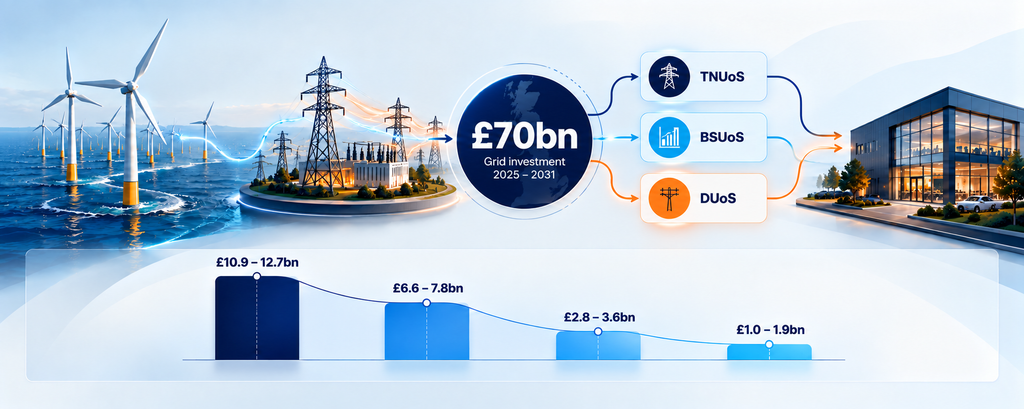
Ofgem estimates that the three companies that own the transmission network (National Grid Electricity Transmission, SP Energy Networks and SSEN Transmission) will need to invest around £70 billion between April 2025 and March 2031. Of that, around £62 billion is for projects that increase the capacity of the grid, with the remaining £8 billion focused on maintaining and renewing ageing infrastructure.
The scale of the step-change is significant. Annual spending on grid upgrades was £2.5 billion in 2025-26 and is set to exceed £11 billion a year from 2027-28, more than quadrupling the current rate of investment. The money funds new overhead lines and underground cables, new and upgraded substations, and major subsea links such as Eastern Green Links 1 and 2, which will carry Scottish wind power down the east coast to County Durham and Yorkshire.
Nor does the investment stop in 2031. The National Energy System Operator (NESO) has recommended a further £89 billion of transmission investment beyond 2030, as electricity demand is expected to more than double by 2050 with the electrification of transport, heating and industry. For businesses, this points to network costs remaining a feature of energy budgets well into the next decade rather than a short-term spike.
The cost of doing nothing: constraint payments
The strongest argument for the upgrade is what happens without it. When the grid cannot carry enough electricity from where it is generated to where it is needed, NESO has to pay generators to switch off in one location, typically Scottish wind farms, and pay others to switch on elsewhere, typically gas-fired power stations in England. These are known as constraint costs, and they are recovered through Balancing Services Use of System (BSUoS) charges on every electricity bill, including yours.
According to the National Audit Office (NAO), constraint costs have risen from £0.6 billion in 2018-19 to £1.9 billion in 2025-26. Because most of this money goes to gas generators asked to increase output at short notice, typically at a premium of around 30% over the day’s wholesale price, the cost is also tied directly to volatile international gas markets.
The NAO’s analysis of NESO’s forecasts shows how sharply these costs depend on grid delivery:
| Grid scenario in 2030 | Forecast annual constraint costs |
| No upgrades to the existing grid | £10.9bn to £12.7bn |
| Planned upgrades, but two critical projects delayed | £6.6bn to £7.8bn |
| All Clean Power 2030 upgrades delivered | £2.8bn to £3.6bn |
| All upgrades plus eight accelerated projects | £1.0bn to £1.9bn |
Source: National Audit Office, September 2026, based on NESO forecasts (2024 prices).
The choice facing Britain is therefore not between spending £70 billion and spending nothing. It is between investing in network capacity now, or paying rising balancing costs year after year for a system that cannot move power where it is needed. Ofgem estimates that, once avoided constraint costs and reduced reliance on gas are factored in, delivering the upgrades on time should leave a typical household around £30 a year better off by 2030-31 than a slower programme.
How grid investment reaches your business energy bill
Grid upgrades are not funded by the taxpayer. They are paid for through energy bills, with Ofgem setting how much the transmission owners can recover through a price control framework known as RIIO. The current period, RIIO-3, began in April 2026 and runs to March 2031, which is exactly when the bulk of the £70 billion will be spent.
For businesses, those costs arrive through three main non-commodity charges:
| Charge | What it pays for | How it typically appears |
| TNUoS (Transmission Network Use of System) | Building, maintaining and upgrading the high-voltage grid | Largely a fixed daily charge, based on your site’s charging band |
| BSUoS (Balancing Services Use of System) | NESO’s day-to-day balancing, including constraint payments | A per-unit charge within your rates |
| DUoS (Distribution Use of System) | The regional networks that deliver power to your premises | Unit rates by time band, plus fixed and capacity charges |
The effect is already visible. The start of RIIO-3 pushed the transmission element of a typical household bill from £51 to £83 in a single year, and Ofgem forecasts the grid-related portion reaching £104 by 2030-31. Businesses pay through their own charging bands rather than the price cap, but the direction of travel is the same, and industry analyses now commonly put non-commodity costs at around 60% of a typical business electricity bill.
That has a practical consequence many businesses only discover at renewal. A fixed-price contract usually fixes the commodity element, but depending on how it is structured, some network charges may be passed through at cost and can change mid-contract. Two quotes with near-identical unit rates can therefore produce very different invoices over a three-year term.
Not sure what is driving your costs?
Volt Solutions provides a no-obligation, independent review of your current bills and contracts, separating commodity from non-commodity charges and checking that your site is in the correct charging band. Book your energy review.
Delays are the real risk, for bills and for growth
While no business can control wholesale markets, the NAO’s central warning is not about the size of the investment but the pace of delivery. Of the 56 ongoing projects deemed essential for Clean Power 2030, 50 are forecast to arrive later than the date NESO considers optimal, and 32 are either off track or face significant risks to their delivery dates. The main obstacles are skills shortages, global supply chain pressure, planning and consenting delays, and the difficulty of taking parts of the network offline to carry out the work.
NESO estimates that delays to just seven of the most critical projects could add up to £6.7 billion a year in constraint costs if they are not delivered by 2030. Every year of slippage on those projects is a cost that ultimately flows back through balancing charges to businesses and households.
Grid capacity also matters for businesses planning to expand. The proportion of projects offered a transmission connection at the date they requested fell from 64% in 2019-20 to just 16% in 2023-24, with the average wait stretching from 18 months to 57 months.
For manufacturers adding electrified processes, logistics operators installing EV charging, or developers planning data centres and new sites, access to power is increasingly a planning constraint in its own right, not just a line on the bill.
Will businesses benefit in the long run?
There is a genuine long-term upside, even if it arrives after the costs. Ofgem estimates that in 2025 the wholesale gas price set Britain’s wholesale electricity price around 90% of the time. With the grid able to carry more renewable power to where it is needed, it expects that figure to fall to around 30% by 2030-31, reducing how often electricity prices are dictated by international gas markets.
That matters for any business that lived through the 2022 energy crisis. As we explored in our articles on the growing importance of LNG in Europe’s energy security and whether green power is making energy prices more stable, gas remains the single largest source of price volatility in the UK market. A stronger grid is one of the main routes to reducing that exposure.
The trade-off is timing. The costs of the upgrade are front-loaded into network charges now, while the benefits in lower constraint costs and less gas-driven pricing build gradually over the late 2020s and 2030s. In effect, today’s businesses are helping to fund the energy system of the future, which makes managing the controllable parts of energy spend more important than ever.
What your business can do now
No individual business can influence the cost of Britain’s grid, but every business can control how well its energy contracts are structured around it. With network charges set to keep rising through RIIO-3, the organisations that fare best will be those that look beyond the headline unit rate.
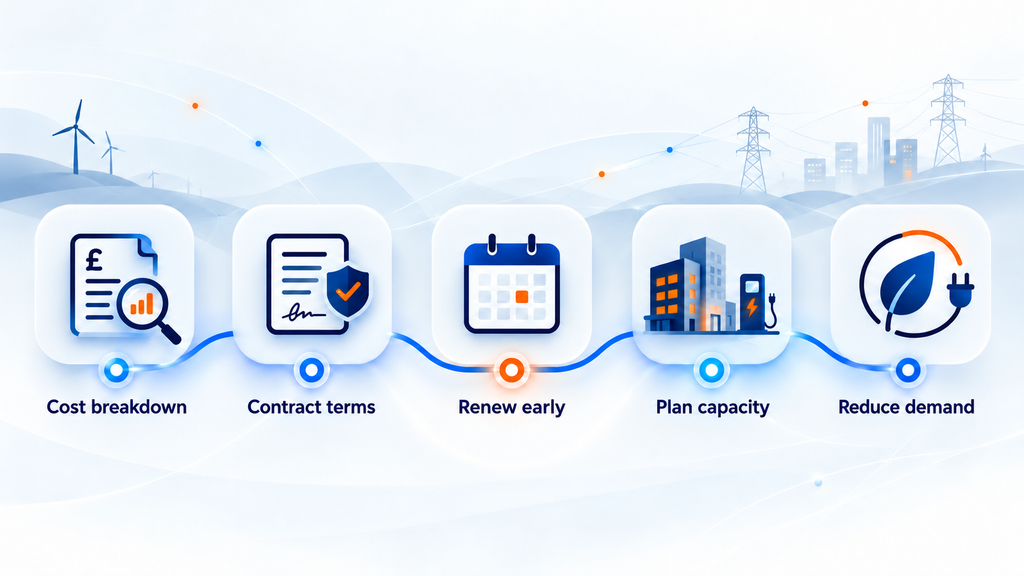
- Understand your full cost breakdown. Knowing how much of your bill is commodity and how much is network and policy cost is the starting point for any sensible procurement decision. Volt Solutions breaks this down for every client, so budgets are built on the full picture.
- Check how your contract treats non-commodity costs. Whether network charges are fixed or passed through determines how exposed you are to future increases during the contract term. We compare both structures across our supplier panel to match your appetite for risk.
- Plan renewals well ahead of expiry. Suppliers price known network increases into new contracts, so timing and market conditions both matter. Our team monitors the market continuously and advises clients on when to secure pricing, rather than waiting for a renewal letter.
- Factor grid capacity into growth plans. If you are expanding a site, electrifying processes or adding EV charging, capacity and connection timescales should be considered early. We can help you understand what additional load could mean for your charges and contracts.
- Reduce the load you draw from the grid. Because many network charges are linked to when and how much electricity you use, efficiency improvements and on-site generation can reduce exposure to rising costs over time.
Turn rising network costs into a smarter energy strategy
Britain’s £70 billion grid upgrade will shape business energy costs for the rest of this decade and beyond. The wholesale market is now only part of the story, and procurement decisions made on unit rate alone risk leaving businesses exposed to the charges that are rising fastest.
Volt Solutions works with businesses across the UK to simplify energy procurement, compare pricing across a broad panel of suppliers, and structure contracts around each organisation’s operational needs. Whether your contract is approaching renewal or you simply want clarity on how network costs will affect your budget, our team can give you an independent view.
Speak to Volt Solutions today. Request your no-obligation energy review and find out whether your current contract and procurement strategy are still working in your favour.
Frequently asked questions
Who pays for Britain’s grid upgrade? Energy consumers, not the taxpayer. The costs are recovered through network charges such as TNUoS and BSUoS, which appear on both household and business electricity bills.
Will my business electricity costs keep rising? Transmission charges are expected to rise through to 2031 as investment ramps up, although the upgrades should reduce constraint costs and gas-driven price spikes over time. The overall impact on your business depends on your usage, charging band and how your contract treats non-commodity costs.
Can a fixed-price contract protect me from network charge increases? It can, but not always. Some fixed contracts include non-commodity costs for the full term, while others pass them through at cost, so it is important to check the terms before you sign.
References
- National Audit Office, Upgrading the electricity transmission network, HC 589, 11 September 2026.
- Ofgem, RIIO-3 Final Determinations for the Electricity Transmission, Gas Distribution and Gas Transmission sectors, 4 December 2025.
- National Energy System Operator, Clean Power 2030: Advice on achieving clean power for Great Britain by 2030, November 2024.