


For businesses exposed to energy costs, understanding storage dynamics isn’t just useful, it’s a strategic advantage. Storage levels quietly shape wholesale pricing, influence supplier behaviour, and ultimately determine how volatile your energy bills might become.
Why Gas Storage Matters More Than It Seems
Gas storage acts as Europe’s energy buffer. During the summer months, when demand is lower, countries inject gas into storage facilities. In winter, when heating demand rises, that gas is withdrawn to stabilise supply.
At a glance, storage levels answer a simple but critical question:
How prepared is Europe for future demand shocks?
The scale alone highlights its importance. The EU holds approximately 100–110 billion cubic metres (bcm) of gas storage capacity. This is equivalent to roughly 25–30% of annual demand, and a significantly higher share of winter consumption. Data from International Energy Agency underscores how pivotal this reserve is in balancing seasonal demand swings.
Following the 2022 energy crisis, policy has reinforced this importance. The European Commission now requires member states to reach 90% storage capacity by 1 November each year, creating a structured baseline for winter preparedness.
High storage levels generally signal:
- Strong supply security
- Reduced likelihood of extreme price spikes
- Greater market confidence
Low storage levels, on the other hand, can trigger:
- Aggressive wholesale price increases
- Heightened volatility
- Increased competition for supply
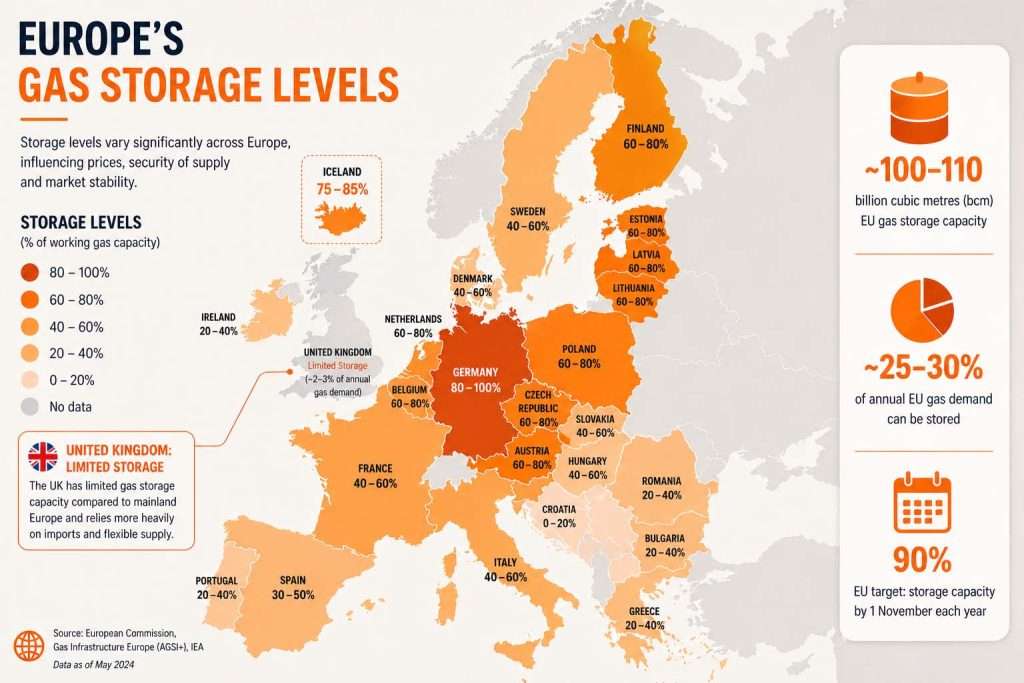
In short, storage is more than a reserve, it’s a compressed signal of overall market health, reflecting LNG flows, pipeline supply, weather patterns, and geopolitical conditions.
The Link Between Storage and Winter Risk Pricing
Energy markets are inherently forward-looking. Prices today reflect expectations for months ahead, particularly for winter delivery.
Recent years have demonstrated a structural shift. Europe has exited winter with 50–60% storage still full, compared to historical norms closer to 30–40% prior to 2022, according to data from Gas Infrastructure Europe. This higher baseline has helped moderate extreme pricing scenarios but the market remains highly sensitive to any deviation.
When storage levels are strong heading into autumn, the market tends to price in lower risk. Suppliers are less concerned about shortages, and forward contracts become more competitive.
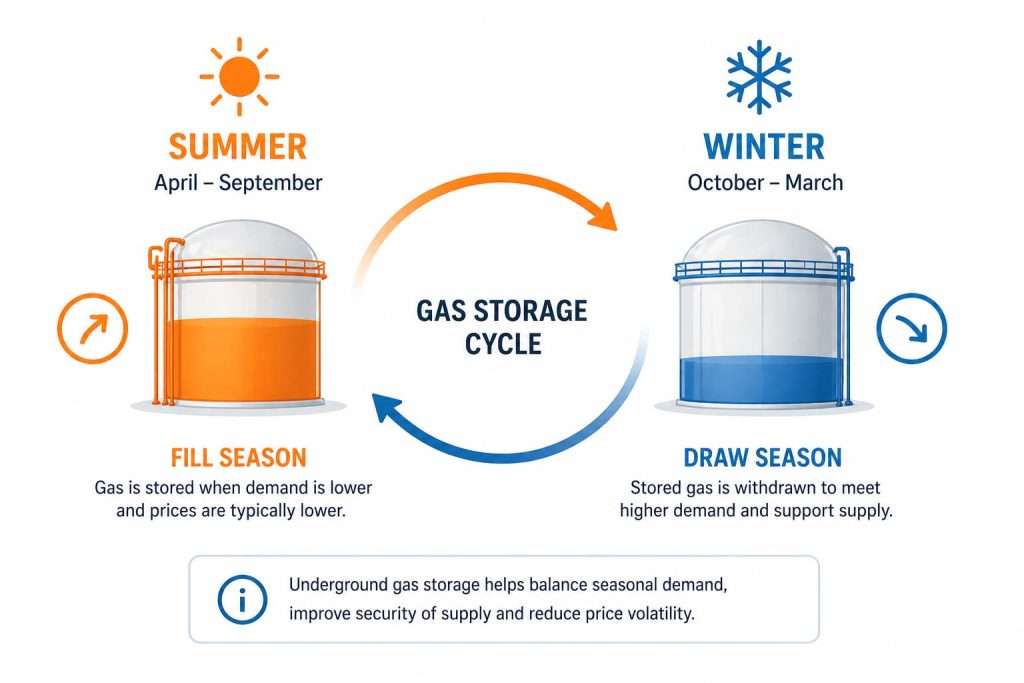
However, if storage levels lag behind seasonal expectations:
- Traders introduce a “risk premium”
- Winter contracts rise sharply
- Volatility increases in response to supply and weather uncertainty
This dynamic has become more pronounced in the post-crisis era. During 2022, European benchmark gas prices surged above €300/MWh, compared to long-term norms closer to €15–€30/MWh. This is a stark reminder, highlighted by the International Energy Agency, of how quickly market balance can unravel.
For businesses, the key takeaway is simple:
Storage levels in summer and early autumn often dictate how expensive winter energy will be.
Summer Buying Strategies: Timing Is Everything
The summer injection season is not just a technical process, it’s a critical window for procurement strategy.
One of the biggest structural changes in recent years has been the rise of LNG. Liquefied natural gas now accounts for approximately 30–40% of Europe’s gas supply, according to both the International Energy Agency and the European Commission. This means global competition for LNG cargoes directly impacts how quickly European storage can be replenished.
When storage is filling steadily and ahead of target:
- Markets tend to soften
- Buying opportunities emerge
- Fixed contracts may offer better value
Conversely, if injections are slow or disrupted, due to LNG competition, outages, or geopolitical tensions:
- Prices can rise even in low-demand months
- Market sentiment turns cautious
- Delaying decisions becomes riskier
A common misconception is that summer always offers the cheapest prices. In reality, pricing is shaped by how storage levels compare to expectations, not just the season itself.
Effective strategies increasingly involve:
- Monitoring storage data weekly
- Layering purchases over time
- Acting early when fundamentals align
Why This Matters for Your Business
Energy is no longer just a cost line. It’s a risk factor that requires active management.
Ignoring storage trends can lead to:
- Locking in contracts at peak pricing
- Missing favourable market windows
- Budget uncertainty driven by avoidable volatility
Conversely, businesses that incorporate storage data into decision-making gain:
- Better procurement timing
- Improved cost control
- Greater resilience against market shocks
Turning Market Signals into Action
At Volt Solutions, we view gas storage levels not as background data, but as a core market signal.
By combining storage analysis with wholesale pricing trends, geopolitical context, and supplier behaviour, we help businesses:
- Understand what’s driving the market
- Identify the right moments to act
- Build strategies that reduce exposure to volatility
Europe’s gas storage levels may not dominate headlines, but they remain one of the clearest indicators of where the market is heading.
For businesses willing to look beyond the noise, they offer something far more valuable than news:
Insight.
If you’d like to better understand how current market conditions could impact your energy strategy, the team at Volt Solutions is here to help. Let’s talk.
References & Data Sources
- European Commission
Gas Storage Regulation and EU energy policy
https://energy.ec.europa.eu/topics/energy-security/gas-storage_en - Gas Infrastructure Europe
AGSI+ (Aggregated Gas Storage Inventory) platform
https://agsi.gie.eu - International Energy Agency
European gas market reports and LNG supply data
https://www.iea.org - Intercontinental Exchange
European gas benchmark pricing (TTF), referenced via market reporting and analysis